
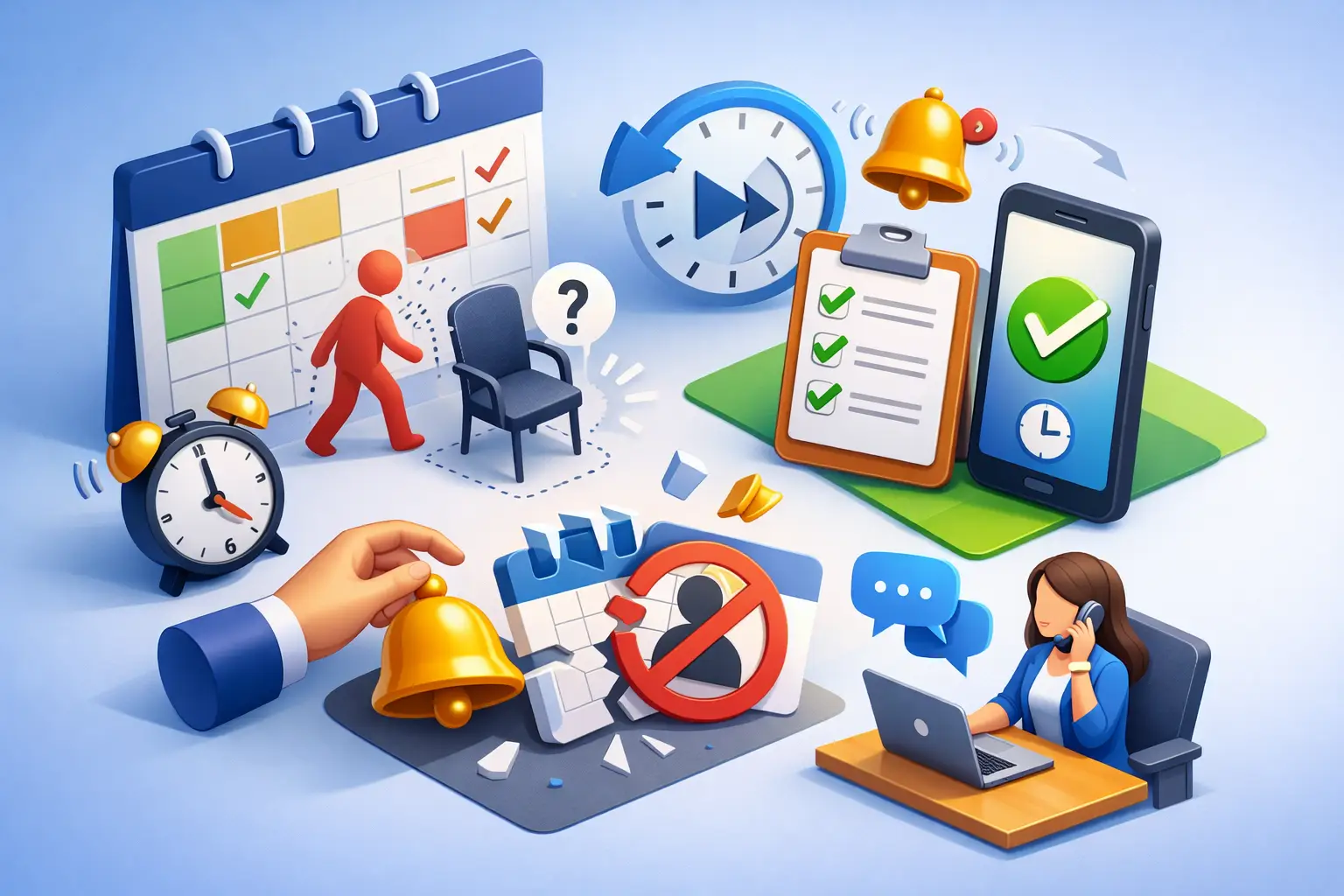
Every missed appointment costs more than the empty time slot. It throws off staffing, weakens cash flow, creates idle gaps in the schedule, and forces your team to spend even more time chasing people who were already supposed to show up. If you are looking for how to reduce appointment no shows, the answer is rarely a single reminder. It is a tighter operating system around booking, confirmation, communication, and follow-up.
Service businesses usually do not have a no-show problem. They have a process problem. When customers forget, get confused, double-book themselves, or go silent after scheduling, that usually points back to gaps in the experience you gave them before the appointment ever began.
Why appointment no-shows happen in the first place
Most no-shows are predictable. The customer did not fully commit, did not get enough reminders, did not understand what happens next, or booked too far out and lost urgency. In some industries, price anxiety causes people to avoid the appointment rather than cancel it. In others, friction is the issue – they cannot find the address, they are not sure what to bring, or they need to reschedule but do not have an easy way to do it.
There is also a difference between high-intent and low-intent bookings. Someone who spoke with your team, got clear expectations, and confirmed a time is much more likely to arrive than someone who clicked into a calendar link late at night and never heard from you again. That distinction matters because the fix is not just more volume of reminders. It is better qualification and better communication.
How to reduce appointment no shows with better booking controls
Start at the point of scheduling. If your booking process is loose, your attendance rates will usually be loose too.
Ask only for the information you actually need, but make sure you collect enough to communicate properly. That means a working mobile number, email address, service type, and any details that affect preparation. If your team is still booking appointments without verified contact information, you are setting yourself up for preventable losses.
It also helps to set expectations while the customer is still engaged. Confirmation should not just say, “You are booked.” It should tell them the day, time, location or service format, expected duration, what to bring, and how to reschedule if needed. A vague confirmation creates room for missed details. A clear one reduces uncertainty.
Lead time matters too. The farther out the appointment, the higher the risk of a no-show. That does not mean every business can schedule within 48 hours, but it does mean you should watch where no-shows increase. If appointments booked three weeks out fail more often than appointments booked within five days, you may need a stronger pre-appointment sequence for long-gap bookings.
Use reminders like a system, not a one-time message
Businesses often ask how to reduce appointment no shows and immediately think of reminder texts. That is the right instinct, but a single reminder is rarely enough.
The most effective reminder strategy uses timing, channel, and message clarity together. A confirmation should go out immediately after booking. Another reminder should hit far enough in advance to let the customer adjust their schedule. Then a final reminder should arrive close enough to the appointment that it is top of mind.
For many service businesses, that means one message at booking, one 24 to 48 hours before, and one the morning of or a few hours before. The exact timing depends on the type of appointment. A clinic visit, training class, home service call, and fitness session do not all behave the same way. The right cadence depends on how far customers travel, how much prep is required, and how disruptive a missed slot is to your team.
Message quality matters just as much. Reminders should be short and specific. Include the appointment time, business name, location or service window, and a direct call to confirm or reschedule. Avoid burying the key details in a long message. People scan. Write for that reality.
Make confirmation and rescheduling easy
One of the fastest ways to cut no-shows is to stop forcing customers into silence. If someone cannot make it, you want that information early, not after the appointment starts.
That means confirmation and rescheduling should be simple. If the only way to cancel is to call during business hours, some customers will do nothing instead. A text-based confirmation flow works better because it meets people where they already respond. A simple reply of Y to confirm or a prompt to reschedule can save the slot before it is lost.
This is where automation has a direct operational payoff. When confirmations, reminder sequences, and follow-up responses are managed inside one communication workflow, your staff spends less time manually checking attendance risk. A platform like ResQEngage is built for exactly that kind of control – keeping booking, messaging, reminders, and follow-up connected instead of split across separate tools.
Reduce no-shows by increasing customer commitment
People are less likely to miss appointments they have actively committed to. Passive bookings create passive attendance.
You can strengthen commitment in a few practical ways. Ask customers to confirm. Send prep instructions that require attention. Use deposits when the appointment value or no-show cost justifies it. In some industries, even a modest booking fee reduces casual no-shows because it creates a real decision point.
That said, deposits are not always the right move. For low-ticket or relationship-driven services, they can add friction and reduce conversions. If you are considering them, compare the gain in attendance against the loss in bookings. The right answer depends on your margins, customer expectations, and how scarce your appointment inventory is.
Language also matters. Customers are more likely to show when they understand the value of the appointment. Instead of treating the booking as a generic calendar event, frame it as the next step in solving their problem. If they see the appointment as important, they are less likely to treat it as optional.
Segment your no-show strategy by appointment type
Not every appointment should be handled the same way. A new patient consult, recurring class, estimate visit, and certificate renewal session have different attendance patterns and different risks.
New leads often need more reassurance and more reminders because they do not yet have a relationship with your business. Returning customers may only need simple confirmation and a day-of prompt. High-value appointments may justify personal outreach from staff if confirmation is missing. Lower-value recurring appointments may be better handled with automated sequences and waitlist backfill.
This is where many businesses leave money on the table. They use one reminder template for every customer and every service, then wonder why results are uneven. If you want to reduce appointment no shows consistently, segment your communication based on service, customer history, and lead time.
Watch the warning signs before the appointment is lost
No-shows rarely come out of nowhere. There are usually signals. The customer does not confirm. Messages go unopened. They ask vague questions that show confusion about the appointment. They book but never complete intake forms or prep steps.
When those signs appear, your team should not be guessing what to do next. Build a clear response path. If a customer has not confirmed by a certain point, trigger an extra reminder. If a high-value appointment is still unconfirmed, assign an outbound call. If someone cancels, move them into a rebooking workflow immediately instead of letting the opportunity disappear.
The operational win here is consistency. Staff should not have to remember every next step manually. The more these actions are standardized, the less revenue leaks through avoidable gaps.
Measure what actually improves show rates
If you are serious about reducing no-shows, track the problem with enough detail to act on it. Overall no-show rate is useful, but it is not enough.
You should know which appointment types miss most often, which locations or staff calendars have higher rates, how lead time affects attendance, and whether text, email, or phone confirmation performs best for your audience. This is how you move from reacting to missed appointments to preventing them.
It also helps to separate no-shows from late cancellations. They are related, but not identical. Late cancellations may point to scheduling friction or weak rescheduling options. True no-shows often point to weak commitment, poor reminders, or unclear instructions. Different causes need different fixes.
The real goal is not more reminders
The businesses with the lowest no-show rates are usually not the ones sending the most messages. They are the ones running the clearest system. Customers know what they booked, why it matters, when to show up, and how to respond if plans change. Staff are not scrambling. Follow-up is not improvised. The schedule stays tighter because the process is tighter.
If your calendar has too many empty slots, start by looking at the operational path between booking and arrival. That is where most no-show revenue is won back. A better customer experience on the front end usually solves what looks like an attendance problem on the back end.
The practical shift is simple: stop treating no-shows as random customer behavior and start treating them as a workflow you can improve.